



How often, upon meeting a fellow Buddhist meditator for the first time, do you find yourself exchanging autobiographical accounts of how each of you first discovered the practice? If your experience is anything like mine, the answer will be “very often,” if not “practically all the time!” And very often, in my experience, the story I hear from my new-found acquaintance describes some kind of ongoing unpleasant issue in their life, something they were struggling to resolve without success, which eventually prompted them to take up mindfulness meditation as a means of trying to resolve it.
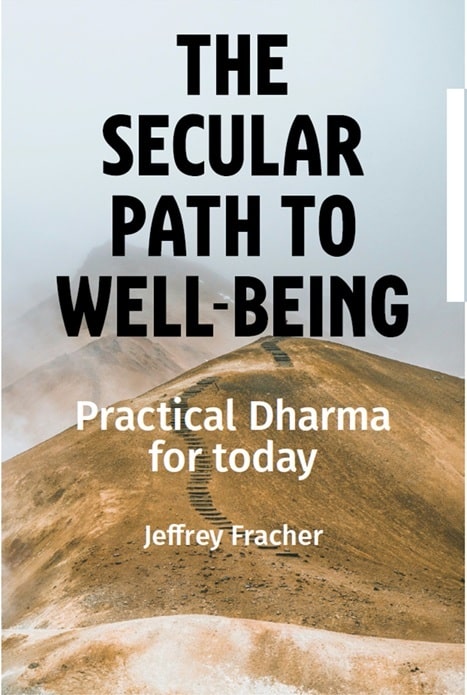
Sound familiar? Hearing such an account always resonates with me, since my own story is very much of that nature. And I suspect that such accounts also resonate deeply with Jeffrey Fracher, the author of this remarkably helpful new book exploring the parallels between the teachings of ancient Buddhism and the insights of modern psychology.
Fracher is a recently retired clinical psychologist who serves as the guiding teacher of Serenity Sangha, a virtual community of Buddhist practitioners based in Charlottesville, VA. He brings his 44 years of clinical experience along with his 35 years of Buddhist practice to both the members of his sangha and the readers of this book (as well as to the subscribers to his weekly online Substack newsletter Practical Dharma). Of equal importance, he also brings his own personal history to us in The Secular Path to Well-Being, sharing numerous candid details from his past and his present life, in order to illustrate how the “practical dharma” he’s urging us to bring to our lives has so powerfully impacted his own.
So, what exactly does Fracher mean by “practical dharma”? In his preface, he defines it as “the combination of a secular Buddhist perspective with modern psychological theory.” Referring to Stephen Batchelor’s pragmatic approach to the teachings of traditional Buddhism, Fracher emphasizes that practical dharma points to “actionable steps that focus on how to live skillfully in the modern world … [and] is a call to engage directly with our lived experience in a way that is grounded, practical, and deeply transformative.” It opens up the possibility for us to achieve a greater sense of the “well-being” suggested by his title.
The book’s seven main sections, each consisting of several short chapters, can be divided into two distinct parts. The first four sections rest on the foundation of Batchelor’s four-task ELSA model, familiar to many practitioners of Secular Buddhism. Each section in this opening part is titled sequentially after those four tasks: (1) Embrace life; (2) Let reactivity be; (3) See reactivity stop; and (4) Actualize a path. The last three sections serve as a coda to the first four, each of the three exploring in depth the topics of human flourishing, relationships, and finally, death and grieving.
There is such a wealth of topics addressed in the four ELSA-themed sections that I can only list them, without discussing them in greater detail. Here is a sampling: reducing reactivity to the different levels of suffering that come our way; accepting the fact of impermanence; letting go of our fixed ideas about how things ought to be; understanding and skillfully managing our natural ego needs; dealing with guilt and shame; becoming more aware of both healthy and unhealthy desires; handling anger; taming anxiety; reducing impatience.
A central theme that recurs throughout these early sections, and perhaps the key to successfully bringing the benefits of practical dharma into one’s own life, is to practice a triad of skills that Fracher terms “noticing, pausing, and discernment.” By cultivating a mindful awareness of our present-moment experience, we learn to notice whenever any of the phenomena listed in the above paragraph is occurring, to pause so as to examine the bodily and mental reactions that are arising in us, and then, based upon what our examination reveals, to discern what we need to do in order to bring about a skillful resolution to, rather than an unskillful continuation of, the problem situation.
“Integrating the path,” the concluding chapter to the fourth section “Actualize a path,” was for me the heart and soul of the book. Here is a passage from that chapter, in which Fracher offers this inspiring view on the transformative nature of pragmatic dharma: “This transformation does not mean that life becomes free of challenges. As we all know, life is hard and suffering is inevitable. The dharma does not promise to eliminate all difficulties. It does, however, offer us tools to navigate them with wisdom and grace … [and] to help us live a more awakened life. This does not mean achieving some lofty state of enlightenment that feels out of reach for ordinary people. Rather, it means living with greater awareness, compassion, and integrity in our daily lives. It means showing up fully for ourselves and others, making choices that align with our values, and cultivating a sense of gratitude and joy in the face of life’s challenges.”
As was noted above, the three concluding sections that follow this chapter delve deeply into the topics of flourishing, relationships, death and grieving. Each of them is written with the same intention of helping readers live more skillfully amidst the ever-present forms of suffering we all encounter at one time or another. Fracher ends his book with a most helpful Afterward, in which he offers us five “final reminders” of how to progress with our own practice of practical dharma, most notable among which are the triad of noticing-pausing-discernment that was discussed above.
Whether you are just getting started with the teachings of Buddhism, or have been practicing its tenets for years or even decades, The Secular Path to Well-Being can provide you with a wealth of pragmatic guidance as you traverse the path you have chosen.
You will be able to purchase the book from 27 April 2026 by clicking here.


