


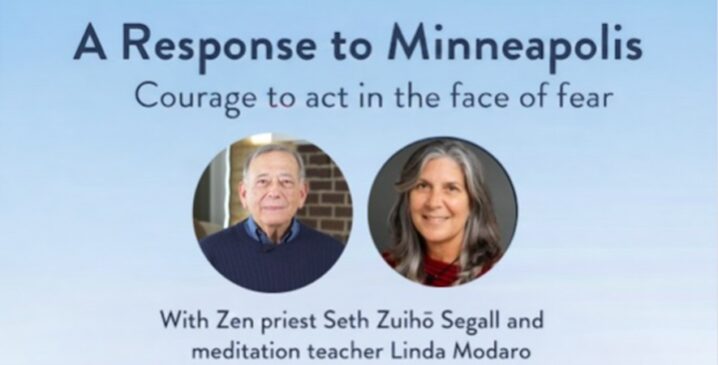
The Trump administration’s actions in Minneapolis – the violation of constitutional rights, the terrorizing of both documented and undocumented immigrants, and the murder of Renee Good and Alex Pretti – have horrified Americans and led to a mass movement in the city to protect people’s rights and resist the federal government’s assault.
To give Buddhist practitioners an opportunity to share how we might best support each other in these difficult times, on February 5, Tricycle: The Buddhist Review sponsored an on-line event entitled “A Response to Minneapolis: Courage to Act in the Face of Fear”. The Zoom meeting featured a talk by Zen priest and psychologist Seth Segall, who is on the Coordinating Committee of the Buddhist Coalition for Democracy (BCD), and a meditation and reflection facilitated by Linda Modaro, the guiding teacher of Sati Sangha and the facilitator of BCD’s weekly meditation group.
Both Seth and Linda have contributed articles to the Secular Buddhist Network website.
Seth began by describing our current political context and how he believes Buddhists can respond. He acknowledged that, in response to the brutality and harmful attacks on our democracy and rights by the Trump administration, many people feel hopeless and helpless. Yet, millions of Americans are responding in a variety of ways. Seth emphasized that each person needs to find their own way of responding, taking into account both our vulnerabilities and capacities. For some, that will mean becoming directly involved in mass protests; for others, it will involve participation in mutual aid efforts, such as bringing food to those who are scared to leave their homes. Finally, some will need to focus on self-care and reflection to provide themselves with the energy and strength to reengage. There is no one right way to respond.
Seth pointed out that Buddhism recognizes both our tendencies toward greed, hatred, and delusion, as well as our capacities for mindfulness and compassion. Rather than aim to eliminate all greed, hatred, and delusion, our goal as Buddhists should be to try to cultivate our positive qualities and to improve social conditions.
Linda then led a 10-minute meditation, followed by a 5-minute period in which the 325 people on the Zoom call were encouraged to journal or reflect on what they experienced in the meditation, including what key questions and ideas emerged in their meditation.
After the mediation and reflection period, Linda invited the participants to share whatever ideas and/or questions that had come up for them. Many did so, and their comments demonstrated both the intense emotions that were present among the group and the heartfelt desire among everyone to come together as community in order to process those emotions in a compassionate manner.
Then, as they brought the meeting to its conclusion, Linda and Seth each offered a brief closing remark. Linda urged everyone to take the time to continue processing what they had heard from others and thought to themselves during the meeting, and Seth expressed his gratitude to all the participants for allowing themselves to be seen and heard in such a respectful manner, so that everyone could learn from each other.
This event was a great opportunity to listen, share, and reflect on how we might best support each other and ourselves through our present, difficult moment.
To view the event, click below:
I thank Tom Cummings for his contribution to the article.


