



Editor’s Note: This article originally appeared on the website of Buddha-Stiftung, a sister, secular Buddhist organization in Germany. We thank Jochen Weber and Regina Tröscher for their kind permission to repost the article on the SBN website.
**********************************
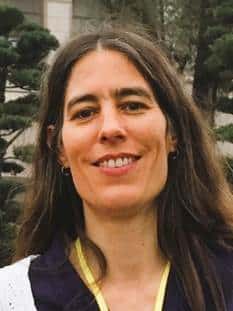
With Saskia Graf's passing, we have lost a companion, a close colleague, and a friend. Much of what the Buddha Foundation is today bears her mark. Much of what we have experienced, built, and endured in recent years, we have experienced together with her.
We met Saskia in 2017 at the Buddha Foundation's first symposium. This encounter led to a collaboration, which in turn blossomed into a friendship, and from that friendship, that special bond that develops when you work together for years on something truly important to you. Since 2018, she has volunteered for the Buddha Foundation, and over the years this has grown into a deep connection: with the foundation, with both of us, with Stephen and Martine Batchelor, with Mike Slott, as well as with Sharon Tobias and the Secular Buddhist Network in the USA.
When we think of Saskia, a scene from spring 2020 often comes to mind. We had prepared a symposium on ethics and secular Buddhism, in person as always. Then came Corona. Within a few days, we had to decide: cancel or move it online. Hardly anyone knew Zoom back then, and we weren't really familiar with it either. Saskia supported us in trying anyway. With her technical understanding and steady hand, she helped us find a path that almost no one had yet taken. And we succeeded.
Another memory is lighter and full of joy: a visit to the rock arch with Saskia. We can still see her before us, cheerful, enthusiastic, completely present in the place with which she felt so deeply connected. This enthusiasm was typical of her. Saskia could be serious, clear, and thorough, but she could also be genuinely enthusiastic, and anyone who has experienced that never forgets it.
A path to Dharma
Before joining our organization, Saskia held a management position in the business world. A serious chronic illness forced her to give up this career path. It was during this time that she came into contact with Buddhism. What began as a personal quest has, over the years, developed into extensive Dharma work for others.
Saskia possessed a rare combination of qualities: organizational competence, linguistic precision, personal experience, and fundamental humanistic convictions. She was a member of the Humanist Union. For her, Buddhism and humanism were not contradictory. She was united by the question of how people can live more freely, responsibly, compassionately, and clearly.
Translation as bridge building
A particularly important part of Saskia's work involved translating key works of secular Buddhism. This work took place at a time when AI tools did not yet facilitate translation. It required patience, linguistic sensitivity, and the ability to bridge cultural and philosophical divides.
Saskia translated, among other works, Stephen Batchelor's "How Buddha Came to the West" and "The Art of Being Alone," Robert M. Ellis's "Buddha's Middle Way," Martine Batchelor's "Learning to Let Go," Winton Higgins's "Secular Buddhism Workbook," and Mike Slott's online course "Secular Buddhism."
This work was more than just linguistic translation. It was bridge building. Saskia helped to make texts and practices accessible that opened up a new approach to the Buddha-Dharma for many people in German-speaking countries: undogmatic, experiential, ethically oriented, and open to the present.
Her close connection to the texts led to a close connection with people. Over the years, she developed a personal friendship with Stephen and Martine Batchelor. A trusting collaboration also grew with Mike Slott and Sharon Tobias. Saskia had become part of a worldwide secular Buddhist network: not as a vocal representative of a particular school of thought, but as a reliable and insightful voice.
Rooms for practice and discussion
Equally influential was Saskia's commitment to vibrant communities of practice. She initiated and moderated numerous online groups, most recently "WortWechsel" (Word Exchange). These groups created spaces where people could engage in conversation about Dharma, everyday life, doubts, and ethical questions.
She had a knack for bringing people together, structuring conversations, and keeping spaces open without putting herself in the spotlight. Even when organizing and facilitating online retreats, she provided a calm and supportive presence for many participants.
Her work was never merely organizational. It was an expression of an attitude: people need places where they can engage seriously, openly, and trustingly with their lives, their questions, and their practices. Saskia helped create such places.
BuddhiRefuge: Compassion in concrete help
Another important part of her commitment was the BuddhiRefuge aid project in Thailand, which she initiated and oversaw. The project supports traumatized women and children and helps create safe living spaces where protection, stability, and development are possible.
Here, too, Saskia's understanding of Dharma was evident: compassion does not remain abstract. It manifests itself in concrete help, in protection, in the willingness to take responsibility. For her, BuddhiRefuge combined Buddhist practice, humanistic ethics, and practical commitment.
Trans-traditional, secular, humanistic
Saskia pursued her path openly and across boundaries. She was deeply connected to secular Buddhism, but not limited to it. She sought connection, not separation. She cultivated contacts with teachers from various Buddhist traditions and moved between secular Buddhism, classical lineages, Zen practice, and social activism. She also participated in the Secular Buddhism Working Group of the German Buddhist Union.
What interested her was not belonging to a school, but the effectiveness of the practice: Does it help people become freer? Does it help to alleviate suffering? Does it promote clarity, responsibility, and compassion?
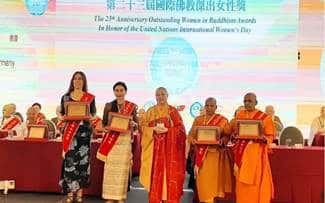
For her commitment, Saskia was awarded the “Outstanding Women in Buddhism Award” in 2024. The honor recognized her contribution to an open, secular, and at the same time cross-traditional Buddhism.
Connected to the rock gate
In recent years, Saskia also worked as a manager at the Felsentor Center. She remained deeply connected to this place, the practice community there, and the people there until her death.
The fact that Saskia was able to work at both the Buddha Foundation and Felsentor speaks volumes about her. She didn't operate in contradictions. She was able to take on responsibility in different contexts because she saw the common ground: the practice, the people, and the potential for transformation.
Illness, practice, and a final journey
After her health had stabilized, Saskia unexpectedly received a cancer diagnosis in 2025. She began fighting the disease. At the same time, she herself spoke of how her long-standing Dharma practice helped her to deal with her situation calmly and thoughtfully.
We accompanied her as best we could during this time, and we owe her a great deal during these months. She remained clear-headed in a special way. Not in the sense of an idealized image of strength, but as a person who had not only taught, translated, or organized the Dharma, but lived it in an existential situation. What we were privileged to experience with her during these months was a gift that will stay with us.
Shortly before her death, she married her partner, whom she had met just a few months before her diagnosis. There was something deeply moving in that, too: to say yes once more, to love, intimacy, and life, amidst illness, farewell, and uncertainty.
Thanks to
For us, Saskia was far more than a volunteer. For many years, she was a particularly close companion. She shared the core idea of the Buddha Foundation, helped to put it into practice, and shaped its profile in a quiet, consistent, and effective way.
Much of what she did remains. In the books she translated. In the people who, through her, found access to practice and dialogue. In the groups she initiated and facilitated. In BuddhiRefuge. In the networks she helped to build. And in our memory of a person who dedicated her strength, her experience, and her love to serving others.
We are grateful for Saskia's life, her work, and her friendship.
Saskia, thank you.


4 Replies to “Saskia Graf, 1979 – 2026: A life dedicated to Dharma, humanism, and compassion”
Dear Jochen and Regina, Thank you for sharing this beautiful memorial to your colleague and dear friend. it’s good to know that you all had each other’s company and love. It teaches beautifully about dharma practice.
Very sad to hear the loss of her.
It is a heartbreak to hear of the loss of Saskia. My sincerest condolences to all who knew her… family, friends and sangha. May her bright spirit live on in all our hearts as an inspiring legacy for all of us.
Sorry to hear that Saskia is not alive anymore. My heartfelt condolences for you all who worked with her. I had the privilege a few years ago to see her at work while setting up the mindfulness based ethical living course with her as a facilitator. She was indeed a very helpfull and modest person. Thank you for the beautiful remembering, that was nice to read!