CONNECTING SECULAR BUDDHISTS WORLDWIDE
CONNECTING SECULAR BUDDHISTS WORLDWIDE

POSTS:
All Posts

A New Italian SBN Website
Riccardo Migliorelli has created a new Italian website for Italian speakers at https://www.buddismosecolare.it, a gateway designed to help Italian-speaking people discover the SBN and its rich library of resources.

What Do I Want to Do With This Life?
Linda Modaro and Nelly Kaufer assert that "Right Livelihood" is not just about choosing the right job but participating in a world that is not entirely aligned with our values, without giving up those values altogether.

The Doubting Disease: A Buddhist’s Struggle with OCD
Bernat Font discusses his experiences with OCD and the approach - based on dharma and cognitive behavioral therapy - which has helped him to live with greater ease with this condition.

A Review of Jeffrey Fracher’s The Secular Path to Well-being
Tom Cummings reviews Jeffrey Fracher's book, The Secular Path to Well-being: Practical Dharma for Today. The book offers strategies that provide practical, accessible applications of dharma teachings to the dilemmas we all face.
War Journal
As a secular dharma practitioner, Carmel Shalev reflects on her experiences living in Israel during a time of war.

Taking the Wheel: A Secular Buddhist Approach
Alan Bodnar explains how mindfulness can mitigate the impact of the "self-driving system", our tendency to be reactive.

Dave Smith’s interview with Mike Slott on Secular Buddhism & SBN
Dave Smith discussed the current status of secular Buddhism, the notions of secularity and spirituality, and the development of the Secular Buddhist Network with SBN Editor Mike Slott.

We’re All Downstream
Noah Rasheta discusses how Buddhism has evolved, his view of the term "secular Buddhism", and a new offering on his website, eightfoldpath.com.

Climate Action & Eco-Grief
John Danvers discusses global warming, climate action and "eco-grief". He contends that individual and collective actions rooted in dharmic values can transform potential despair into a more hopeful outlook.

A Response to Minneapolis: A Tricycle Online Event
Tricycle magazine sponsored an on-line event entitled “A Response to Minneapolis: Courage to Act in the Face of Fear”, which featured a talk by Zen priest Seth Segall and a meditation and reflection facilitated by Linda Modaro, the guiding teacher of Sati Sangha.

A practitioner’s journey to secular Buddhism: John
John Clinton Bradley moved away from a conservative form of Christianity to embrace a combination of humanistic Christianity and secular Buddhism.

The mistake of “applying” the practice: the sponge cake approach
Bernat Font believes that it is more helpful to think of daily tasks and situations as the material we use to cultivate meditation skills rather as a place to "apply" them.
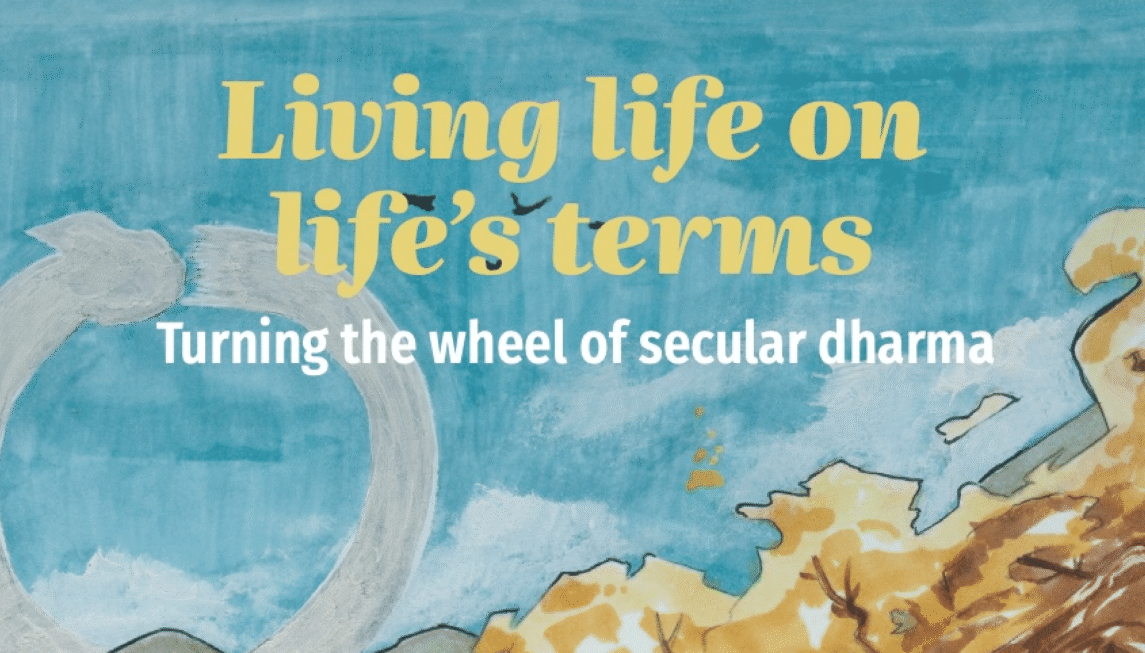
Tuwhiri’s next book: ‘Living life on life’s terms’
Tuwhiri, the secular Buddhist publishing imprint, will shortly be publishing ‘Living life on life’s terms: turning the wheel of secular dharma’ by Stephen Batchelor, Martine Batchelor and Bernat Font.

Dave Smith’s Course on Essential Dharma
Dave Smith is offering a 3-month practice and study program which will focus on the 32 dimensions of awakening that appear in the early Buddhist Pali tradition, the Theravada Abhidarma, and later schools of Buddhism alike.
Ezra Klein Interviews Stephen Batchelor on “What is this?”
Ezra Klein, a New York Times columnist, interviewed Stephen Batchelor. They discussed the Seon Buddhist meditation practice of What is this? and Batchelor's reframing of the Four Noble Truths as four tasks.
EXPLORE BY SECTION
SEARCH THE SITE
RECENT POSTS


