



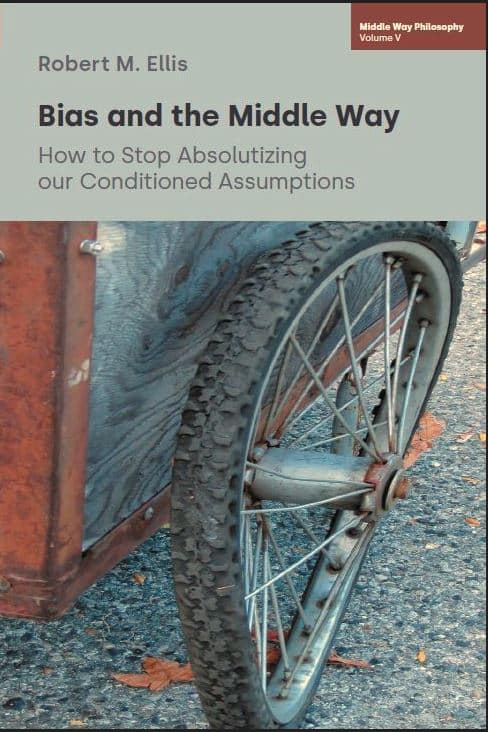
Humans are biased. We are constantly making judgements that are ill-considered, maladaptive, and conflictual. Our best intentions are often not fulfilled by our judgements in practice. The recognition of bias is central to the Buddha’s insights, with the origins of the term ‘dukkha’ (the First Noble Truth) possibly being derived from ‘a wonky chariot wheel’, and in that sense resembling the origin of ‘bias’ from a bowling ball that does not track straight. Our wonky wheel of bias is thus the source of our problem – not of ‘suffering’, but of inadequate responses that make our suffering worse, by making us veer sideways when we mean to go straight ahead.
That’s why I decided to dedicate the latest volume of my Middle Way Philosophy series to the topic of bias, and to put a wonky wheel on the cover of it. Very often different disciplines and traditions resemble the blind men of the Buddha’s parable, all feeling the elephant in different places, and all apparently finding different things that they fail to connect with each other.
Buddhist practice and bias in cognitive psychology are two such feels of the same elephant, which need to be fully connected to each other, yet too often they are understood in entirely different ways.
Buddhist practice may draw on many traditional formulations from different schools of Buddhism, but not the empirically backed analysis of well over two hundred biases that cognitive psychology has assembled over the last seventy or eighty years. Psychological discussions of bias, on the other hand, seldom take into account the effects of meditation practice, or of any wider path of practice, in addressing it.
Daniel Kahneman, for instance, perhaps the most well-known psychologist of bias in his book Thinking Fast and Slow, starts off that book by stating his view that we can make little impact on addressing our own biases, even if we can sometimes identify those of others. From the standpoint of Buddhist practice, I find that unnecessarily pessimistic.
Buddhist practice offers a whole co-ordinated approach to one’s biases (the Noble Eightfold Path). Yet discussion of biases either in psychology or in self-help literature tends to treat them piecemeal, focusing only on some biases out of those 200-odd and not others. For instance, we may be troubled by our tendency to procrastination and want a solution to help us get on with the tasks that should be taking priority. However, procrastination is just one of the many biases we may have in relation to time, including for instance the sunk costs fallacy, the status quo bias, and neomania (an obsession with new things). Time biases, in turn, are just one of several categories of human bias.
Our awareness of any one of those biases can add to our overall awareness in important ways, but only if we address them as part of a whole practice. Our response needs to include working with our mental states (‘meditation’ in the widest sense), ethical precepts to guide our behaviour, and developing wisdom to understand the sources of our biased judgement – the Buddhist threefold path of meditation, morality, and wisdom.
In my book, then, I set out to place biases in a practical framework, and also to survey them broadly so as to help readers see them in relation to each other. This is how, I think ‘bias training’ needs to operate, if it is to be effective. Most often, however, ‘bias training’ only focuses on racial or gender biases in the way we respond to others: not that these biases are not important, but that they are interdependent with a whole structure of other biases in our habitual judgement.
Racial bias, for instance, is a specific case of ingroup-outgroup bias: the tendency to judge ambiguous information about people within the group we identify with more favourably than about people beyond it. Ingroup-outgroup bias is in turn part of a wider pattern of shortcuts we often use to operate effectively in the short-term (in one limited environment), but at the expense of our longer-term effectiveness. We learn to trust those who resemble us more readily than those who do not, and that works until we are placed in a situation in which it important to trust someone who is not much like ourselves.
Perhaps we learn to operate within our community, but are then stuck when we travel; or perhaps we adopt political attitudes that prioritize the short-term interests of our group, but at the expense of the longer-term welfare of the wider world. It is deeply ineffective to try to address racial bias, like any other specific bias, outside the context of our wider default assumptions and attitudes.
Our response to bias also needs the application of another core insight of the Buddha – the Middle Way – in the whole way we frame it. In the story of the Buddha’s early life there is an illustration of the kind of two-stage critique we need to go through in order to avoid polarized absolute assumptions. The Buddha first ‘goes forth’ from the Palace, with its limited conventionality, to engage in spiritual practice in the Forest, under the instruction of religious teachers with a universalized approach. However, the Buddha soon also sees the limitations of these teachers’ assumptions, and moves on to his own recognition of the Middle Way, combining the best-adapted features of both Palace and Forest.
The polarized absolute assumptions that frame the discussion of bias are those of freewill and determinism: both of which, I argue, we need to decisively avoid in order to find the most effective practical response to it. On the one hand is the freewill assumption – that if we are sufficiently ‘rational’ we can override our biases as a matter of deliberate choice. On the other is the determinist assumption – that we can’t help our biases and thus may as well just accept them: they are drilled into us, after all, by our genes, our culture, and perhaps our professional training or other particular experience.
The way to avoid the polarized conflict between these two opposing metaphysical assumptions about bias is, I think, to make a distinction between bias and biased judgement. In any given judgement we may make, there is a set of conditions that pushes us in particular directions – that is, our bias. We cannot tell in advance quite how strong that ‘push’ is going to be, but we do also experience having a wider perspective beyond our biases, and using that perspective to modify our judgements. So, we cannot help our biases, but that doesn’t mean that we have to make biased judgements.
To avoid biased judgement, we don’t take the bias (or indeed, a reaction against it) as the whole story but apply a wider awareness to make a judgement that takes the bias into account but is not simply dominated by it. For instance, we may recognize the possibility of getting on with that thing we need to do, rather than procrastinating; or we may recognize the possibility of not just reacting to someone’s race but seeing them as a more complex person in a bigger context (in which race is only one element).
Mindfulness practice is central to the cultivation of that awareness, and research by Adam Lueke and others has shown the value of mindfulness in addressing bias. But meditation is also not always effective unless it is part of a wider path. Mindfulness needs to be applied as wider awareness of new possibilities at the point of judgement, when we might otherwise by dominated by our biases. Ethics can also prompt that wider awareness.
The deliberate study of biases can add an important element to our practice of responding to dukkha. We can get a handle on something if we name it, because it then places that thing in a wider context of awareness. So, it can really help those on the wider practical path of Buddhism to make extensive use of the labours of cognitive psychologists, even if they have a wider vision of how to address those biases that the psychologists often seem to lack.
Studying biases and learning their names is, of course, only a first step, but one that can enable us to then start identifying them in our own meditation and reflection. In my own experience, learning about, say, the Forer Effect (that makes me over-detect when other people may be talking about me), or the Sunk Costs Fallacy (that makes me reluctant to abandon a failing project), or the Action Bias (that makes me feel I should be seen to be doing something, even when nothing would be better) can really help overall practice. But that’s only if we see it in the context of overall practice to begin with.
********************
Bias and the Middle Way is available from Equinox Publishing: https://www.equinoxpub.com/projects/bias-and-the-middle-way


2 Replies to “Our wonky wheel: Why Buddhist practice is a response to bias”
Identifying our biases could be seen as getting “insights” into deeper habit patterns but what does the research show about how to abandon them, when unskillful, and cultivate them, when skillful?
Hi John, In my experience, cognitive psychology does not usually frame things in that way: the ideas of skilfulness and unskilfulness are Buddhist ones. One can find helpful approaches in some therapies, especially Cognitive Behaviour Therapy (CBT), which are supported by some research. However, these are generally framed by a medical rather than a practice model, and the research is equivocal about whether any one kind of therapy approach is better than the others: more seems to depend on the personal relationship with the therapist than on the type of therapy. But CBT is a good place to start if you are interested in how far bias research has actually been applied within a practical context.