


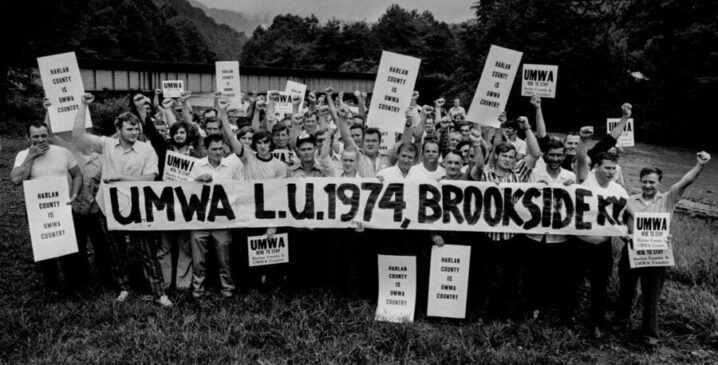
In 1931, in the midst of an economic depression in which millions of people in the US were suffering from unemployment, poverty, and hunger, coal miners in Harlan County, Kentucky fought for better wages, safe conditions, and recognition of their union, the United Mine Workers. This was a bitter and violent struggle. The coal mine operators, backed by local police, private security guards, and state authorities, used violence and intimidation to break the union’s organizing drive. This conflict was social class warfare in its most elemental and naked form; the two sides were clearly defined and there was no middle ground for resolving the dispute at the time.
Florence Reese, the wife of a union organizer, wrote a song that year about the struggle, “Which Side Are You On?” The song became famous in the labor movement as an anthem for those fighting against exploitation by employers and the need to be steadfast in the struggle. Click here to hear Pete Seeger’s rendition of the song.
While conditions have changed since 1931, we still live in a society marked by sharp economic, social, and political conflicts in which we too have to decide what our position will be. A prime example of course is the rise of MAGA/Trump and authoritarianism in the US, which has been challenged by a growing resistance. Or consider the expanding power and control of capitalists like Elon Musk and Jeff Bezos over workers and the vast majority of people in the country.
What should Buddhists do in the context of such conflicts? Should we get involved? If we do get involved, which side are we on? And, if we choose a side, what should our specific role be?
The Approach of Non-involvement
Let me begin with what I think is unfortunately a significant viewpoint among western, convert Buddhists, even those who consider themselves politically progressive. It is the notion that Buddhism is primarily a way for individuals to transform their lives, however that is defined. For some, Buddhism provides unique tools, such as meditative practices, to live a more peaceful and less stressful life. For others, Buddhism is a spiritual path which leads to an understanding of ultimate reality (reality as “it really is”) and freedom from the suffering that is an inescapable part of our lives. In either case, it is the individual’s transformation which is sought; and the problems and conflicts in society are a separate matter. In this way, Buddhism becomes a compartmentalized practice, disengaged from social problems and conflicts.
At the extreme, this approach leads to the view that what really counts is the process of individual transformation and social engagement is seen as superfluous to the prime objective of making progress along the path. Deciding which side to be on simply doesn’t matter.
For some Buddhists who avoid social engagement, a stance of non-involvement is justified on the grounds of a non-dual perspective. Gotama, the historical Buddha, emphasized that the world consists of a web of constantly changing, interrelated causes and conditions. Human beings are part of this web; we are inseparably connected to other human beings, non-human animals, and nature. When we choose a side and engage in activism, we inevitably create a false dualism between a “good” and “bad” side, which, it is claimed, is inconsistent with the basic truth of interconnectedness and our common humanity.
Of course, a non-dual perspective has been used for the opposite purpose — to support social engagement. Thich Nhat Hanh’s notion of interbeing is the basis for a socially engaged Buddhism rooted in our common humanity and our responsibility to ensure that all beings are as safe, peaceful, and happy as they can be.
Another Obstacle: The Demand for Universal Loving Kindness and Compassion
I’ve participated in many discussions with Buddhists who are political activists. One issue that often comes up is how to reconcile political activism with Gotama’s injunction to cultivate universal loving kindness and compassion. On the one hand, politically engaged Buddhists recognize that, in the context of social and political conflicts, there are a small group of people, an economic and political elite, who are more powerful and exercise control over others. To maintain their power and control, the elite exploit and oppress the vast majority, causing great social harm. These Buddhists understand that they need to get involved on the side of those who are relatively powerless to reduce suffering and promote human flourishing for all. But, on the other hand, they are concerned that they are somehow not being “true” Buddhists if they are unable to show the same love and compassion for the exploiter as they do for the exploited.
I wholeheartedly agree with the aspiration to cultivate loving kindness, compassion, sympathetic joy, and equanimity — Buddhism’s four Brahmaviharas. As Insight meditation teacher Sharon Salzberg noted in a retreat that I attended, the goal is to develop these attitudes as deeply and broadly as we can so that they become default modes in our relationship to ourselves, other people, and the world.
But the notion that activists have to feel and display the same loving kindness and compassion for Donald Trump or Benjamin Netanyahu or Elon Musk as for those who are harmed by these powerful men is mistaken. This demand assumes that being a good Buddhist requires one to extend loving kindness and compassion to all, irrespective of the conditions and context.
The first problem here is that this approach is based on the assumption that the full realization of the Brahmaviharas requires us to become free of all hate and greed. The standard or model for such an achievement is the Bodhisattva, who, out of universal love and compassion, vows to postpone their own liberation and access to nirvana to help all sentient beings achieve liberation.
Such a standard assumes a supernatural realm (i.e., nirvana) and the perfectibility of human beings. As a secular Buddhist, I find these assumptions deeply problematic. In my view, the goal of our practice is to shift the balance in ourselves toward greater mindfulness, compassion, insight, and care; and away from those aspects of ourselves which cause harm. We are complex, limited beings who have the capacity for both good and bad; we will never be perfect in relation to some ultimate standard.
Just as important, the Brahmaviharas do not stand alone as guides in terms of how we can live better. The cultivation of these emotional attitudes is an important aspect of the path, but so too are the understanding of causes and conditions, the ability to discern what is most appropriate in complex situations, and the overall goals of reducing suffering and promoting human flourishing.
A Different Approach to Taking Sides: Recognizing History, Structure, and Power
Why is it crucial to take a side in economic and political conflicts which are marked by an asymmetrical power relationship between a small elite and the vast majority of working people? Or between one group that has more power and control over another group, who they dominate and harm through various forms of discrimination, oppression, and disrespect?
We take a side because, as a guiding principle, we seek to do the least amount of harm — to ourselves, to other human beings, and to the world. We want all beings to suffer less and have the maximum opportunity to flourish in the best ways that they can. When one class or country or group (i.e., one side) uses their power and control to exploit, oppress, and/or discriminate against another class, country, or group, the dominant side causes great social harm, increases the amount of suffering, and denies many people the opportunity to flourish.
Thus, taking sides in this context is consistent with and supportive of Buddhist ethical values (doing no harm, care, and compassion). It is also a recognition of our interdependence and common humanity.
However, to discern which side to take and the most appropriate ways of taking a side, we need to understand the history, structures, and power dynamics of any particular conflict. It is particularly important that we are alert to the complexities and nuances of a conflict. Even if it’s clear that one side needs to be supported, we can cause harm if we ignore these complexities and create a false, absolute dichotomy between the “good” side and the “bad” side.
At an abstract level, the Buddhist notion of causes and conditions is a helpful way of seeing the interconnected, processual nature of reality, but it doesn’t offer us specific theories and strategies for understanding economic, social, and political conflicts. In my view, we need radical theories and perspectives — such as Marxism, ecosocialism, critical race theory, feminism, and others — which help us discern the complex forms of these conflicts and the most appropriate ways to challenge powerful structures and individuals.
Integrating core Buddhist ideas and values with such radical perspectives is thus essential. We are able to discern what side to take, but we also understand the pitfalls of demonizing the other side and viewing the conflict as a fight between good and evil.
We focus our compassion and loving kindness on those who are harmed by powerful elites or groups. We support the struggles of those fighting back against exploitation, oppression, and discrimination. But, at the same time, we recognize the common humanity of all and seek ways to make these struggles as non-violent and compassionate as possible.
Another way of saying this: We are passionate about the struggle against social injustice, economic inequality, and discrimination. We feel deep anger about social harms. Yet we try to imbue struggles with a sense of love and care.
Back to the Struggles in the Coal Mines
John Sayles’ movie, Matewan, is about the struggles of miners in Matewan, West Virginia in the US in 1920 to organize a union in the face of violent opposition from the coal mine owner and their hired thugs. One of the main characters is Joe Kenehan (played by Chris Cooper), an organizer for the union who is sent to Matewan to support the coal miners. Kenehan is not a Buddhist, but his approach to organizing is basically what I have advocated above — being a mindful and compassionate presence in the midst of conflict.
Joe is clear-eyed about the exploitation faced by the coal miners and recognizes that only militant action can force the coal mine operators to recognize the union. He focuses on uniting the workers, who are initially divided by race and nationality, so that they can conduct a successful strike. At the same time, he advises the workers not to counter the company’s violence with armed force. At least for a time he is successful; the different groups in the union come together, the strike is effective, and the movement grows. But when the company’s thugs kill several of the mine workers, he is unable to stop the violence that explodes and he becomes the victim of that violence, shot and killed by one of the private security guards hired by the company.
The movie closes tragically, with the recognition that violence is deeply embedded in human relationships. Yet, Joe’s efforts are not in vain. For, at the end of the movie, one of the young coal miners reflects years later — as an old man — on what Joe brought to the struggle and how it changed his understanding of how workers can unite for justice.
Very few of us are in the situation where the fictional Joe Kenehan was. Yet, like Joe, we have a responsibility to work with and support those who are being exploited, oppressed, and discriminated against. We need to take a side. And by using Buddhist values and radical perspectives, we can do so in ways that overall reduce suffering and promote flourishing.


8 Replies to “On Taking Sides”
6-23-26
Thanks for writing this, Mike. My challenge is fear of violence from the other side (I grew up in the Jim Crow south in the 1940s and 50s). Your essay reminds me of the special kind of courage that arises in solidarity. Your writing about John Sayles great film “Matewan” and your choice of the photo of the Brookside Strike brings to mind Barbara Kopple’s documentary “Harlan County, USA.”
In the late 70s when I worked for a local arts council doing oral histories of seniors in Jewish hospitals, I somehow got a copy of her film and screened it on the wall of the hospital community room. Slowly sick and aged people got up out of their beds and came into the hallway: they recognized the music. They were mostly the immigrant generation of the 1910s and 20s who had worked organizing the needle trades on the east coast (I remember one man told me that before unionization he and his brothers carried parts of the industrial sewing machine on their backs to the sweatshop.) In secular dharma’s ethics of care, solidarity is “caring with.” Thanks for inspiring that courage in me, your reader.
Hi Mike
Not taking a side, in this day & age, is taking a side.
As Buddhists we have to be anti-othering (I know who I am, I’m not those people!).
People are getting juiced and are addicted to this NFL NATION side-taking addiction.
It’s not real!
How do we initiate change related to not believing your thoughts?!
Thank you, Mike, for this well-thought piece. I do have a certain allergy to the phrase ‘taking sides’, as it so often ends up referring to the absolutes of ‘good’ and ‘bad’ sides, but I think you express well the duty to avoid this pitfall.
Something I find inspiring from the description of ‘right speech’ is the element of uniting those who are separated, or in other words, to promote reconciliation. That to me is the goal, one which should accompany our focus on one group of people, which as you say, we often need to do. I think our thought should always be: how can we help this conflict end? …be resolved?
I believe we Buddhists should move from the internet culture of “just say who you stand with” to finding small actions that actually reduce some harm.
Thank you for this piece and especially for stressing that understanding and knowledge of causes and conditions is essential in deciding how to respond to social harms and injustice.
I appreciate this essay very much and share the conviction that the dharma cannot be indifferent to exploitation, injustice, ecological destruction, or the misuse of power.
You write that many Western Buddhists see Buddhism primarily as a path of individual transformation, with social and political life becoming a separate matter. Certainly this tendency exists. Buddhism can become another form of private self-improvement, concerned mainly with reducing one’s own stress or cultivating one’s own wellbeing. But I wonder whether this framing overlooks another possibility.
What if practice isn’t primarily about self-improvement at all? When the sense of being a separate, self-existing individual begins to soften, the very distinction between inner work and outer engagement becomes increasingly porous.
As the sense of separation loosens, participation in life becomes more immediate. Compassion is not something added afterwards as a moral obligation. It emerges because the boundary between “my concerns” and “your concerns” is experienced differently.
Rather than contrasting individual transformation with social engagement, I wonder whether the more interesting question is how the quality of our awareness shapes the quality of our participation.
Two people may work for the same cause. Both may stand with those who are vulnerable and oppose injustice. Yet one may be driven primarily by certainty, anger, and identification with a position, while the other acts from openness, responsiveness, and an ongoing willingness to meet each situation afresh.
Perhaps the distinctive contribution of Buddhist practice is continually returning to the quality of mind from which we act.
For me, that changes the question from, “Which side are we on?” to, “How do we take a side?”
Can we oppose injustice without reducing other human beings to fixed identities? Can we remain open enough to meet people before meeting our concepts about them? Can our commitment to justice be expressed in ways that do not unconsciously reproduce the patterns of certainty, reactivity, and separation that give rise to suffering in the first place?
Those questions do not weaken social engagement. They shape the how of engagement, and perhaps the how is just as important as the what.
Thanks, Ann, for your comment. I agree with much of what you say. I too am concerned about the question of “How do we take a side?” and that we need to avoid othering and essentializing our political and economic adversaries.
However, I want to emphasize that I don’t just contrast individual transformation and social engagement, and claim that the latter is more important. Both processes are essential and mutually support each other. Yes, as you say, individual transformation marked by the softening of the egoic self has a positive impact on how we relate to others and social problems. But the same is true of healthy forms of political activism. When we come together in solidarity to fight injustice of whatever form, we not only develop the capacity to work with others in a democratic and egalitarian manner; we also become more capable of caring for others and broadening the notion of “we”.
Hi Mike,
I’ve been part of SBN for less than a year, but I already feel completely at home in the community. Thank you for everything you’ve done to help create and sustain it.
As a liberal, I’m broadly on the same side as you and appreciate the values expressed in this and your earlier posts. Having practiced Buddhism for almost four decades—and having followed Stephen Batchelor since the publication of his first book—I also consider myself a fellow secular Buddhist.
That said, I do have one concern. I think there’s an important distinction between active engagement for peace and justice and endorsing particular political or economic approaches to achieving those goals. For example, having grown up in the Soviet Union, I came away believing that Marxism is fundamentally misguided, and I don’t share the view that its disastrous consequences in every socialist country were simply the result of poor implementation.
Likewise, after more than sixteen years at a regulatory agency, I’ve come to believe that many of the most effective progressive advances arise through thoughtful, pragmatic rulemaking grounded in a deep understanding of the systemic causes of social problems. In that respect, I think Buddhism offers many valuable tools—especially its insights into dependent arising and the conditions that give rise to suffering.
My concern is that if progressive values become too closely identified with a particular political philosophy, secular Buddhism may unintentionally alienate people who share its existential outlook and ethical commitments but differ on questions of public policy or political theory.
I don’t mean this as criticism. I simply hope we can continue to keep the tent as broad and welcoming as possible. If this is something you’d ever like to discuss further, I’d be happy to continue the conversation.
Thanks again for all your work.
Kindly,
Boris
Boris,
First, I want to reassure you that the Secular Buddhist Network is a big tent which welcomes any one who has an interest in a secular approach to the dharma, whatever their political, spiritual, or philosophical orientation. Articles on the website and the monthly newsletter reflect that diversity.
My particular approach to secular Buddhism and political engagement is shared by some people who participate in SBN online groups or are readers of the website. But based on talking with people in different groups over the last seven years, my sense is that most people involved in SBN would characterize themselves, like you, as liberal. I welcome the political diversity within SBN, just as I enjoy exploring Buddhist ideas and practices with those who feel a strong connection with different Buddhist lineages – Zen, Insight meditation, Theravada, and so on.
Finally, I want to note that when I referenced Marxism in the article – along with several other radical perspectives which help us to understand social conflicts – it was not the kind of Marxism prominent in the Soviet Union. I believe that the Soviet Union was a deeply undemocratic and repressive regime, and that the “official” Marxism used to justify the regime became a dogmatic orthodoxy rather than a method to critically understand society.
Like other important perspectives, including Buddhism, there are a lot of different interpretations of Marxism. For me, the Marxism which is still valuable is humanistic and non-deterministic. Marx’s historical materialism identifies the exploitative and conflictual dynamics of capitalist society and the means for transforming that system, namely human solidarity and creativity within a mass, democratic movement of working people.