

POSTS:
Seth Zuiho Segall
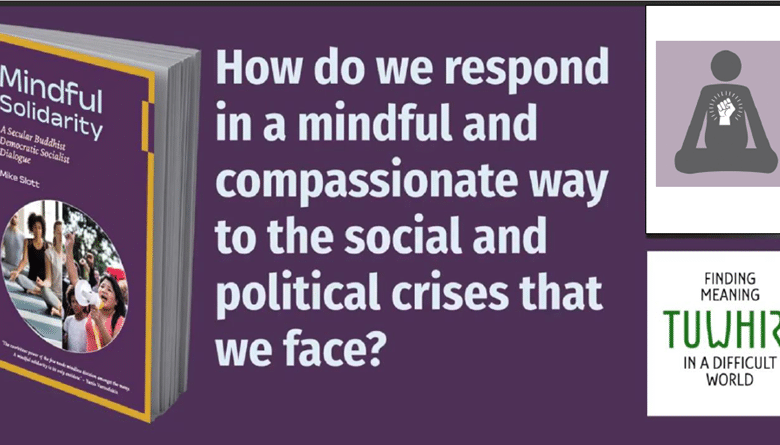
An Online Discussion of Mindful Solidarity
On January 30, at 7 pm US Eastern Time, Craig Murphy, Seth Zuihō Segall, and Karsten Struhl joined Mike Slott for a discussion around his book, Mindful Solidarity: A Secular Buddhist Democratic Socialist Dialogue. The online discussion was sponsored by the Secular Buddhist Network and Tuwhiri, a secular Buddhist publishing imprint.

An interview with Seth Segall on his new book, The House We Live In
SBN interviewed Seth Zuihō Segall about his new book, The House We Live in: Virtue, Wisdom, and Pluralism. In this book Seth offers a theory of ethics and flourishing based on Aristotle, Buddha, and Confucius.

Engaged Buddhism: vision, hopes, and cautions
Seth Zuihō Segall offers a naturalistic Buddhist vision of flourishing which recognizes both our capacity to make positive social changes and the need to be pragmatic in our approach.

Towards a flourishing-based ethics
Seth Zuiho Segall brings together the virtue ethics systems of Aristotle, the Buddha, and Confucius with the pragmatists' emphasis on provisional truths and democracy to offer a new flourishing-based ethics.

Zen’s two paths
Seth Zuiho Segall highlights how in Zen the path of the gradual cultivation of wisdom and virtue and the path of immediate presence, are complementary, each facilitating and enriching the other.

A dialogue on secular dharma
At an online program on Perspectives on Secular Dharma, Stephen Batchelor, Seth Zuihō Segall, Karsten Struhl, and Mike Slott engaged in a wide-ranging dialogue on key topics related to a secular approach to the dharma.

John Dewey, flourishing and Buddhism
Seth Zuihō Segall argues that the Buddhist notions of non-self, interdependence, impermanence, and dukkha need to be situated in the broader framework offered by John Dewey's pragmatic theory.

What is eudaimonic enlightenment?
Seth Zuihō Segall proposes a model of eudaimonic enlightenment that he believes integrates the best of the Buddhist and Aristotelian approaches. It is based on a version of Buddhism that is pragmatic and naturalistic, and that has the enhancement of individual and collective flourishing both within a single lifetime and over the course of long-term social development as its ultimate goals.

Seth Zuihō Segall and Winton Higgins debate the meaning and value of secular Buddhism
Beginning with Seth Zuihō Segall's article, 'Why I am not a secular Buddhist,' Seth and Winton Higgins have engaged in a dialogue on SBN about the meaning and value of secular Buddhism. They have discussed the notion of secularity, religion and religious experience, the role of community, and other key issues.

The dialogue on secular Buddhism continues: Winton Higgins’s surrejoinder to Seth Zuihō Segall’s rejoinder
In his reply to Seth Zuihō Segall's rejoinder in the debate over secular Buddhism Winton Higgins explores the meaning of secularity, religion, and the everyday sublime. He argues that a secular faith is not opposed to religion but is characterized by a deep engagement, a wholehearted commitment, to living this, our one and only life, meaningfully.

The dialogue on secular Buddhism continues: Seth Zuihō Segall’s rejoinder to Winton Higgins
Seth Zuihō Segall continues the dialogue on secular Buddhism by offering a rejoinder to Winton Higgins' response to his article, 'Why I Am Not a Secular Buddhist.' Seth discusses the nature of the religious attitude, the role of community and traditions, and his non-dual perspective.
Winton Higgins responds to Seth Zuihō Segall’s ‘Why I am not a secular Buddhist’
Winton Higgins asserts that Seth Zuihō Segall mistakenly assumes that all secular Buddhists support a 'scientistic' form of secular Buddhism which is hostile to religion. In fact, many secular Buddhists advocate an 'interpretive' approach which integrates dharmic insights with modern perspectives to promote human flourishing in this life.

Why I am not a secular Buddhist
Seth Zuihō Segall considers his 'naturalized' and 'eudaimonic' approach to Buddhism 'close cousins' to secular Buddhism. Yet, he believes that the word 'secular' implies a set of connotations he does not wish to affirm.
EXPLORE BY SECTION
SEARCH THE SITE
RECENT POSTS


