


Part of what gives religion its staying power are practices and rituals that help orient followers in an uncertain world. These often have official titles such as the Ten Commandments of Judaism and Christianity, the Five Precepts of Buddhism, and the Code of Hammurabi in ancient Babylonia, which serve similar purposes of guiding the lives of its adherents. Though they may begin as a helpful guide, it's not uncommon (largely because of the human tendency to take things too literally) to turn them into rigid expectations. History is littered with wars, schisms, and infighting over interpretations of the very precepts meant to bind people together.
In a previous SBN article, I had advocated for a moderate path between two historical traditions, Buddhism and philosophical pessimism, as a way to find a gentler approach to life’s unavoidable difficulties. Part of the motivation for this project is to address the same patterns noted above: humanity’s striving for perfection, overindulgence in dichotomies, and continual search for relief of suffering. Here I wish to pursue a similar project of mediation, focusing specifically on a mode of living, or set of guidelines, that incorporates the wisdom of the two traditions while hopefully avoiding some of the pitfalls that have befallen each tradition. To do so, I will explore a modified version of the Buddhist Noble Eightfold Path that is maybe less noble and more infused with a generous forgiveness towards our human tendencies.
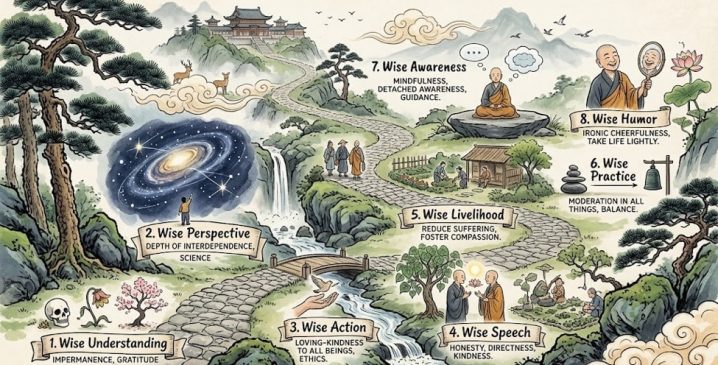
These eight guideposts propose a path to relieve human disappointment and suffering. They include: wise understanding, wise perspective, wise action, wise speech, wise livelihood, wise practice, wise awareness, and wise humor. By “wise” I simply mean useful, rather than some truth arrived at through transcendent experience. I’ve gathered these from various sources,
including Buddhist, humanist, Stoic, scientific, and pessimistic thinkers across the wisdom traditions. My hope is to elucidate a path that is both human and workable.
Wise Understanding
Wise understanding encourages the acknowledgment of a few inescapable facts of living. Inescapable because they occur whether we believe in them or not. These facts include illness, aging, death, and change. The universe is in a constant state of flow. Buddhists call this impermanence, and human beings are as much a part of the flow as subatomic particles and seasons. It is wise, or useful, to accept this because we as human beings tend to waste a lot of energy trying to avoid this fact, to catastrophic consequences. For example, we continue to deplete the Earth’s resources without keeping their limits in mind, which has led to a rather significant existential threat. On a smaller scale, when we avoid uncomfortable emotions, thoughts, or experiences, we make life more difficult and uncomfortable than if we had confronted them outright. I would guess the entirety of the mental health and self-help industry is built on this folly.
Wise understanding encourages us instead to acknowledge uncomfortable truths and face them head-on. We find that, with time, care, and patience, they tend to pass on their own.
Wise Perspective
Wise perspective encourages an openness to the scale and interdependence of the universe we navigate. We have just begun to apprehend the sheer vastness of the cosmos above us and the depth of the quantum world beneath us. We are situated in the middle of a difficult-to-comprehend, swirling reality. This can be disorienting or humbling, depending on how we approach this awareness. The Stoics, as well as Baruch Spinoza, offered a tool to help soothe overwhelm and fixations on our daily worries. In these moments, we are encouraged to take the “view from above” and see our situation from the “aspect of eternity,” reminding us of our finitude.
The Stoic Roman emperor Marcus Aurelius advises us to “sit quietly, close your eyes, and imagine yourself rising above your city. See the streets, houses, and people as if they were an anthill. Rise higher until you see your country, then the earth itself. Let yourself sense how small individual problems become in this vast panorama.”1 Taking a wider view of things can help put our problems in perspective.
Though it is easy to get lost in the insignificance of it all. This is where ecology, biology, and anthropology can help ground us by showing our place in the vast, interconnected web. The Buddhists call this web interdependence. We are inseparably dependent on one another, and part of a seemingly infinite chain of causation reaching back to the Big Bang. Knowing we are manifestations of this magnificent tapestry, woven by cause and effect, helps ground us in our unstable age.
Wise Action
Wise action incorporates the wisdom of the previous two guideposts to help us form a gentle, practical way of being in the world. Our fragile, impermanent nature, along with our deep interconnectivity, offers a way to live lightly in the world. Awareness of how our actions affect such a delicate, fragile web of interrelated beings can soften the heart, even amid tragedy.
Compassion, warmth, and an open humanity grow from this awareness. Despite the seemingly harsh tone of their propositions, pessimists and Buddhists alike call us to slow down and remain soft in the face of life’s harshness. We’re all facing the same groundless conditions. It’s wiser to weather them with friendship, generosity, and care.
Wise Speech
It seems unrealistic to hold ourselves to the expectation of, say, never speaking anything hurtful or flying off the handle in the heat of emotion. Rather, it is wiser to encourage speech that is honest, direct, and kind. Unfortunately, we can never predict how others will respond to our honesty or our attempts at kindness. In most cases, we can’t even be sure if what we’re saying is wholly true! However, we can keep the intention to speak as authentically and considerately as possible, knowing our words affect others. Likewise, we can withhold unnecessary gossip, complaining, or chatter that merely takes up the space a kinder silence could fill.
Wise Livelihood
Human beings have created, for better or worse, a world in which we must trade our time, skills, and energy for money just to survive. While countless economic and political systems have been tried over the ages, the personal sphere seems to be where we have the most control.
What we do to earn our living reverberates into the world and shapes our sense of worth. Outwardly and inwardly, it is wise to spend our time in ways that reduce suffering and foster loving-kindness for all beings. There will likely always be a need for the more unsavory professions, and a gentle pessimism encourages compassion and kindness for those who perform what is necessary to sustain their lives without judgment.
Wise Practice
A practice is a way of orienting oneself toward the myriad of choices presented in daily life. Religion and philosophy alike provide tools to navigate more mundane predicaments in ways that reduce harm and foster caring. Across traditions, the Golden Mean appears as a useful scale for approximating action. It seems wise to choose the middle way between extremes, whether in pleasure, ideology, speech, or commitments. We are finite beings with limits. We get tired, sick, depressed, and overwhelmed. Seeking a balance between opportunity and excess helps make the ride a bit more comfortable.
Wise Awareness
It is helpful to have a respite in life where we can slow down, rest, and reorient ourselves. Mindfulness meditation includes a variety of practices that allow us to do this in a deeply informative and healing way. By learning to notice, in a detached, nonjudgmental manner, the multitude of stimuli swirling within and around us, we can develop a calm center. This guidepost provides the flavor, if you will, to the other seven guideposts. It helps us let go of attachments to how we think the world ought to be and instead learn to accept how it is, moment to moment.
When we learn to accept our thoughts, emotions, and sensations regardless of how uncomfortable they are, we gain freedom from the distractions that perpetuate suffering. In short, we learn to take ourselves lightly.
Wise Humor
This leads to the final, and possibly the wisest, guidepost: developing a sense of humor. This is a skill that I find frightfully missing from most, if not all, religions and philosophies of life. Part of what makes life seem so unpleasant and unworkable is our incessant seriousness about it.
Despite all evidence to the contrary, we should avoid approaching life with the tense fuddy-duddyness we are so often accustomed to. From politicians to priests to academics, much of the world we have created has a dour dullness about it. To the gentle pessimist, all of this is absurd enough to make one roll over on the ground in a fit of laughter.
We are small, finite, fragile beings who walk around as if the whole cosmos is about us. On top of it, we act as if our shortcomings, faux pas, and ambitions are worthy of some god's attention. Yet, the rest of nature continues on, as if it’s a sort of playful indifference. It seems wiser, and more considerate, to let go of our grandiosity and allow our pretense to sift with the sands of time.
We are here for such a short stay; we regularly do absurd, self-defeating, and juvenile things. Why not have a laugh? To quote the Romanian pessimist (and often humorist) Emil Cioran, “I am just an accident; why take it all so seriously?”2
Conclusion
Here we have surveyed a path that hopefully allows us to navigate life in all its profundity and absurdity in a way that is both honest and gracious. Many philosophies promise some gilded future, or transcendent state, to aspire to. Here we welcome the ironic merriment of the somber human being. Our condition is one of paradox and confusion, but it need not be more painful than what nature allows. My hope is that this path offers a delicate way forward as we navigate human fallibility. Pessimism, in my experience, works well for navigating the bounded universe we find ourselves in, with forgiveness and a warm sense of humor.
1 See Meditations, book 7, section 48.
2 See Entretiens (Conversations), a collection of interviews published in 1995 that features various discussions Emil Cioran had with different interlocutors over his lifetime.


