


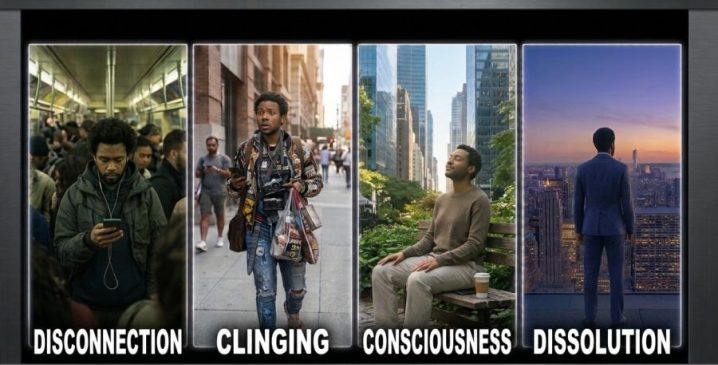
As I discussed in a previous SBN article, during my meditative practice, I identify four highly distinct ways of experiencing the present, which I call "states," although the boundaries between them are blurred:
- In the first, the self is disconnected from the experience and life happens without me noticing: the mind is so busy with a thousand and one thoughts that it finds no pause to perceive the present.
- In the second, the self clings to the experience and a fraction of the mind begins to have space to feel the present, but only in a fragmented way and for moments, because thoughts continue to fight for attention.
- In the third, the self is conscious of the experience and the mind, empty of thoughts, gains awareness of the sensations of the present; nevertheless, an inner voice persists—a kind of guardian—that watches to ensure no thought slips in, narrates what is happening, and memorizes the experience.
- In the fourth, the present is experienced without a self, with the inner voice itself fading away: there is no narrator or guardian, only sensations flowing freely, without an experiencer to process them.
Through introspection and personal exploration, I have been developing techniques that help me transition between these states more fluidly. I know that each person needs tools that resonate with their own nature and worldview, and that what works for me won't necessarily work for everyone. Even so, I would like to share these methods with you, in case any of them inspire you and you want to make them your own or adapt them to your practice.
Between Disconnection and Clinging
Living disconnected from the experience of the present is the state in which I have spent the most hours throughout my life and I would say it requires no special quality or profound knowledge to settle into it. Thus, I won't bother to explain how to transition toward this state. On the other hand, transitioning toward a state where I begin to experience the present, and cling to it so as not to lose the experience, is not quite as simple; it requires effort, willpower, and concentration.
The core premise is to observe the breath closely—the exhalations and inhalations, as well as all the subtleties that arise—and, when a thought or distraction inevitably appears, capturing and blurring our attention, not to get irritated and to refocus on our anchor: the breath. There is also the proposal of mentally naming each of the sensations or thoughts with the intention of becoming aware of them.
Even though I generally directly apply the techniques I will explain in the following sections, sometimes I also use anchoring techniques; yet instead of clinging to the experience of the breath, I try to cling to the simple experience of the present. I understand this might sound a bit strange when read like this, but, in practice, I simply try to retain the current moment, allowing my attention to rest on whatever attracts it most: the breath, the song of birds, my posture, the visual shapes in front of me, a feeling of serenity or love, or the sprouts of thoughts as they arise...
Despite the strength of the anchors, which allow me to cling to the experience of the present, sometimes a distraction is too strong and compulsively drags me back to a disconnection from the experience. That is when identifying what is distracting me becomes crucial: on the one hand, when I detect the thoughts that captivate me, it is easier to stay alert to similar thoughts and prevent them from trapping me again; on the other, this awareness is very useful for the following practice, which is aimed at reducing the intensity of these thoughts in order to let myself go into the experience of the present.
Between Clinging and Consciousness
If you find yourself experiencing the present with consciousness, returning to the state of the self clinging to this same experience is very simple: you only need to remember something, let a thought form, or allow a worry or fantasy to return, and then struggle to cling to the experience of the present and not overshoot it, falling back into the state of the self disconnected from the experience. In contrast, transitioning from the state of clinging to the experience of the present to the self conscious of the experience is not such a simple or obvious step.
Returning to the description of both states, one of the main differences between the two is that in clinging to the experience there are thoughts, and the self is in constant tension to cling to the present and not get carried away by worries or fantasies. On the other hand, in the self conscious of the experience of the present, there are no longer thoughts or any struggle to maintain the experience, even though a very subtle tension and an observing mental process remain. Therefore, for me, the main technique for shifting from the second to the third state consists of starving thoughts until they dissolve.
In practice, the method I use to dissolve thoughts involves identifying and classifying them while I am in the state of clinging to the experience. Next, I repeat to myself that neither these thoughts nor their triggers are important, focusing on the most recurring ones. Even so, occasionally a thought emerges that I am reluctant to label as irrelevant—a worry about family, work, or my personal development. Then, I simply evaluate its other dimensions: even if I classify the cause of the thought as important, is it necessary right now? Would there be any negative consequence if I postponed it for later? If the answer is no, I repeat to myself that this thought is unnecessary. And, if the answer is yes, I accept without drama that the thought captures part of my attention and concludes its reasoning.
Right after repeating to myself a few times that a thought is not important or necessary, I try to return to the experience of the present, listening closely to the silence to perceive if the mind is still generating thoughts. Sometimes I observe sprouting thoughts that, unable to fully form, fade away, finally allowing me to consciously experience the present. Other times, however, thoughts continue sprouting and taking root; then, if I manage to keep them from completely hijacking my attention, I restart the process: I identify them, classify them, and remind myself again that they are not important or necessary.
Curiously, sometimes I have thoughts related to the meditation practice itself, to the difficulties of experiencing certain states, or to the pride of having experienced them... Then I have to repeat to myself that these thoughts are neither important nor necessary. And if they resist dissolving, I try to extinguish the cause of the thoughts and repeat to myself that: meditating is not important, consciously experiencing the present is not important, just as not experiencing it is not important either... I must repeat this to myself with total conviction, believing it with all my heart, because otherwise, it is practically impossible for me to completely dissolve these thoughts and return to experiencing the present with consciousness.
Between Consciousness and Dissolution
Returning to the state of experiencing the present consciously, from the state in which the present is experienced without a self, is simple. One only needs to invoke the self or the inner voice—"I am doing it, I am dissolving the self"—and, the very moment I evaluate or put words to the experience, the inner voice returns and I fall back into experiencing with a conscious self.
On the other hand, dissolving the inner voice to experience the present without a self is not as simple, even though the technique I use is very similar to the one I described for transitioning from clinging to consciousness. If in the previous case the goal was to dissolve thoughts, here the purpose is to dissolve the mental construct that considers itself conscious and identifies as a subject. And, just as before, relativizing or reducing the importance I grant to these mental constructs brings me closer to their dissolution.
According to my observations and introspection, my self exists because I consider myself important. My subjectivity, or the sensation of being an individual, will endure as long as I give importance to my history, my successes and failures, my goals, to what I feel or believe, my principles, relationships, possessions, health... The self, then, is nothing more than the sum of everything to which it assigns value.
In my case, dissolving the self, even if just for a few moments, implies assuming that my existence has no meaning: that I do not matter, that my life does not matter, that I could be dead and the universe would not flinch, that there is no need to cling to anything. I must let go without fear of disappearing or ceasing to be, and, at first, this conviction causes vertigo.
During meditation, when I find myself conscious of the experience of the present and notice the tension to maintain it—that inner voice guarding against any thought slipping in, narrating what is happening, and memorizing the experience to remember it later—I introduce a new thought into the silence to remind myself that it is not important to describe or retain the experience of the present, not even to experience it, that there is no need to be conscious of the experience, nor to live it with a conscious self or without a self: nothing matters, I am not important... In the previous state I could convince myself that the only important thing was this precise moment, but now not even that is important.
Then I fall silent and, without forcing anything, I try to listen without intention, observe without controlling, experience without it mattering... And, sometimes, the self ends up dissolving spontaneously and the present is, simply, experienced.


