


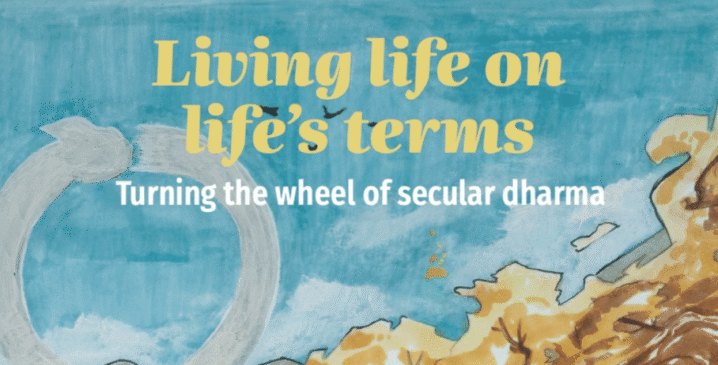
On 27 May 2026, Tuwhiri launched a Kickstarter campaign to pre-sell our next book – Living life on life’s terms: turning the wheel of secular dharma. The proceeds of this Kickstarter campaign will also be used to help us produce, print, distribute and promote the book.
Please support this Kickstarter campaign! It runs to 28 June 2026.
https://www.kickstarter.com/projects/tuwhiri/living-life-on-lifes-terms
This book brings together eighteen talks from the one-year Bodhi College Secular Dharma course, six by each teacher. The course was taught by Stephen Batchelor, Martine Batchelor and Bernat Font, and presented as four modules, one for each of Gotama’s four tasks.
Each module is introduced in the book by one of the course participants, Cathryn Jacob, who sets out what can be found in each chapter. These are:
Module 1 • EMBRACE LIFE
Chapter 1 – Four foundations of mindfulness
Martine Batchelor begins where the body quietly insists that we start. Before we interpret, there is breath, pulse, posture, and the small flicker of feeling tone. She invites us to stay close to this simplicity, to let presence be felt rather than achieved. In her telling, mindfulness becomes an act of affection – attending to the living moment as though it mattered.
Chapter 2 – The four great efforts, or the four resolves
Here, Martine unfolds the resolves not as instructions but as gestures: four movements of the heart that shape how we inhabit our experience. To prevent, release, cultivate, and sustain is to learn the grammar of care. She teaches resolve as creative permission rather than duty.
Chapter 3 – A democracy of the imagination
Stephen Batchelor widens the horizon. He proposes that to embrace life is to create with it – to treat even suffering as material that can be worked. Desire, energy, intuition, and experimentation become tools for shaping reality. Creativity here is participation in the unfinished nature of being alive.
Chapter 4 – Creative awareness
Martine returns to show how creative awareness looks in practice: listening deeply, adjusting lightly, approaching each moment as a possibility. Awareness becomes responsiveness – tending life without tightening around it.
Chapter 5 – A jazz musician walks into a meditation room…
Bernat Font lets the metaphor sing. With jazz as his frame, he describes life as music partly composed and partly unfolding around us. Practice becomes attunement – the courage to respond without securing the outcome. In his telling, embracing life is the willingness to play.
Module 2 • LET REACTIVITY BE
Chapter 6 – The dynamics of care
Stephen opens with the insight that reactivity accelerates through its own momentum. Care interrupts this loop not by extinguishing heat but by refusing to feed it. Letting be becomes a gesture of compassion: acknowledging pain without tightening around it.
Chapter 7 – Cultivating the five powers in meditation
Martine brings this into practice. She shows how confidence, energy, mindfulness, collectedness, and wisdom arise through sitting with intention. These powers become inner supports – the capacity to meet difficulty without repeating it.
Chapter 8 – Confident and focused – an overview of the five powers
Bernat deepens one of these powers. He reframes confidence as imaginative courage – not certainty, but the trust that new responses are possible. Confidence becomes the opening through which release becomes attainable.
Chapter 9 – Māra
Stephen returns with Māra: the voice that discourages, diminishes, or diverts us. Naming Māra is already loosening his hold. Letting reactivity be begins here: recognising the voice that tightens us and greeting it without obeying it.
Chapter 10 – The fire of reactivity
Bernat leads us closer to the heat – the texture of reactivity. Rather than shrink from fire, he invites us to learn from it, allowing awareness to transmute heat into clarity.
Chapter 11 – What we forget about mindfulness
Bernat concludes by returning mindfulness to its ancient meaning – remembering. To let reactivity be is to remember why we practice when it would be easier to forget. In this view, mindfulness becomes the doorway through which compassion returns.
Module 3 • SEE REACTIVITY STOP
Chapter 12 – Wisdom
Stephen begins with wisdom as felt conditionality – seeing how experience arises and ceases loosens the instinct to grasp. This shift opens space, not as escape but as a new beginning. Wisdom becomes the clarity that allows movement without compulsion.
Chapter 13 – The still point of the turning world
Stephen then turns to ‘the still point’ – the experience of reactivity falling away. Nirvana here is orientation rather than withdrawal: the quiet where action becomes possible without being dictated by fear or habit.
Chapter 14 – The experience of awakening
Martine brings this into human scale. Awakening often arrives as the realisation that nothing more is needed. She honours both sudden shifts and slow integration, teaching us to recognise these hinges as invitations into ethical responsiveness.
Chapter 15 – The pleasure of non-reactivity
Bernat lingers on the ease that comes when we are no longer at war with ourselves. The pleasure he evokes is not thrill but release – a sign that something new can move. These moments taste like possibility.
Module 4 • ACTUALIZE A PATH
Chapter 16 – Caring and careful
Martine opens by recasting the path as lived practice: trying, pausing, noticing, adjusting, beginning again. Care and carefulness become companions rather than ideals. Practice becomes visible in how we speak, pause, choose, and repair.
Chapter 17 – Embracing a diversity of voices
Bernat widens the frame to shared life. Ethics here is conversation rather than conclusion – a field that requires humility, listening, and the willingness to remain in relationship through uncertainty. The dharma finds expression in our shared world — in how we listen, act, and live together.
Chapter 18 – Bringing the dharma to light: a task-based model of mindfulness
Stephen closes the cycle by returning the tasks to each other. Mindfulness becomes relational; enacted in belonging and responsibility. Action is not the end of practice but its unfolding – the place where embracing, releasing, and seeing come alive again. The insights once tasted on the cushion are tested in kitchens, conversations, and commitments. Practice loops outward into the world and circles back inward; the cycle is not completed but inhabited.
This Kickstarter will run until 27 June 2026
https://www.kickstarter.com/projects/tuwhiri/living-life-on-lifes-terms


