

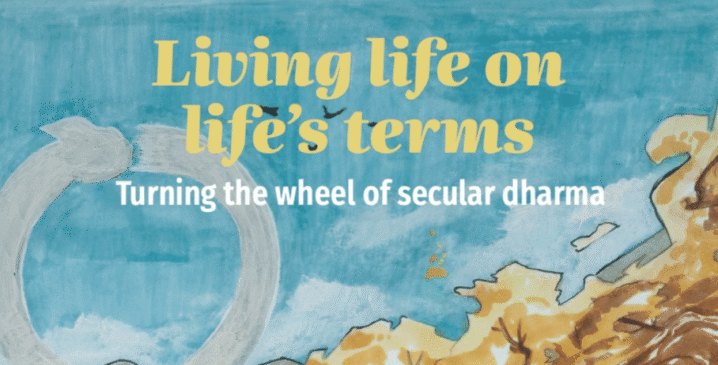
The new book by Stephen Batchelor, Martine Batchelor, and Bernat Font, now available from the secular Buddhist publisher Tuwhiri, is a first-rate transcription of a yearlong, Bodhi College course of 50 seminar talks titled “Secular Dharma: Study, Practice, Community,” which the three authors—all leading teachers of secular dharma—gave in 2021-2022.
As readers of the Secular Buddhist Network will know, Stephen Batchelor is a founder and foremost writer of secular Buddhism, who in his youth was a monk in the Tibetan Gelugpa Buddhist tradition and later in the Korean Seon (or Zen) Buddhist tradition. After disrobing in 1985, he began his long and productive career as a writer, translator, artist, and dharma teacher. His fellow practitioner and spouse, Martine Batchelor, is a leading teacher and writer of secular Buddhism, who in Living Life explores her prior years as a Buddhist nun in the Korean Seon tradition. As a dharma teacher and writer, she has developed her own remarkably original and creative understanding of the dharma.
In 2021, Bernat Font was a student of Stephen’s while completing his doctorate in Buddhist Studies at Bristol University. Prior to his doctoral studies, Bernat had been a professional jazz pianist and teacher. In his own dharma teaching he explores practicing as a musician in developing his distinctive understanding of the dharma. Stephen, Martine, and Bernat each drew on their own unique life histories to teach the yearlong course, and their exceptional lives of creativity and growth are relayed in their book.
Through its excellent development from seminar talks into book form by course participant Cathryn Jacob, Living Life presents the structure, distinct voices, and main themes of the course via its wide-ranging, pragmatic explorations of how to creatively practice the four tasks of secular Buddhism. As developed by Stephen, these four tasks are: to embrace life; to let reactivity be; to see reactivity stop; and, to actualize a path. These tasks are the titles of the book’s four sections.

The four tasks of secular Buddhism differ significantly from the four noble truths of traditional Buddhism in that the tasks are skillful and pragmatic actions situated in our human condition of uncertainty whereas the truths are fixed metaphysical claims.[1] The four tasks, sometimes called the fourfold task, are a cornerstone of secular Buddhism.
This book is a pleasure to read and an important contribution to the growing literature of secular dharma. Divided into four sections focused on the four tasks, the book has 18 chapters (6 from each teacher, which are interlaced throughout so that each task is explored by each of the three teachers). There are several prominent themes, including the significant role of creativity and mindfulness in practicing the four tasks and the exceptional usefulness of contextualizing the four tasks within Stephen’s unfolding Cartography of Care (see this chart at: https://tuwhiri.org/pages/living-life-on-life-s-terms).
The Cartography of Care was an important framework for the yearlong course and the resulting book. It is a conceptual matrix clearly arranged in rows and columns on a 1-page chart, spelling out qualities and virtues practitioners may cultivate in order to live a flourishing life. In the foreword to the book, Cathryn Jacob notes that early in the course “Stephen introduced us to his Cartography of Care, a map that integrates 32 traditional dimensions of awakening—skills and virtues we can cultivate to navigate life with wisdom and compassion. These dimensions are not abstract concepts but practical tools for addressing life’s challenges, fostering resilience, and embracing care as the foundation of a flourishing life.” In effect, The Cartography of Care is a synthesis of secular dharma practice within the ethics of care; and, during the course and beyond it serves as a memory device and touchstone. It is drawn from traditional Buddhism and reimagines the overarching ethical value of care as a way of life.
The pragmatic, varied, and unique approaches of each of these teachers in elucidating how to practice the fourfold task is a highlight of the book. Other focal points include the productive interplay and coherence of their independent voices, and the opening up of creativity as a resource available to all. In this regard, Stephen contests the high-art notion of Western aesthetics that creativity is epitomized by the individual artist-genius. He writes that “…creativity is integral to the practice of human flourishing for every practitioner.”
The teachers approach “dukkha” (suffering in traditional Buddhism or habitual reactivity in secular Buddhism) “…as an important resource on the path of dharma….” The courageous acceptance involved in the task of embracing life is central to secular dharma. As Stephen writes, “we choose to embrace suffering, not push it away. Nor do we choose to embrace it in order to push it away. We accept suffering for what it is, unconditionally—by which I mean unconditioned by greed, by hatred, or by confusion.”
Each of the three teachers uses their own personal experience to illustrate secular dharma practice as a creative endeavor. Each brings especially fresh perspectives on the four tasks and to the many facets of mindfulness which are integral to each of the tasks. I finished reading Living Life with much greater clarity about how mindfulness in secular Buddhism is distinguished from secular mindfulness programs. For example, the book opens on the first task (to embrace life) with Martine’s compelling teaching on ”sati,” the power of mindfulness as dynamically creative awareness: “…One of the main meanings of sati is recollection, or remembering. What are we recollecting, remembering? Often people say that in meditation we are recollecting the breath, or we are recollecting the body, but actually we are recollecting our intention to be aware. We are remembering that we value being aware.”
In the second section of the book (on the task to let reactivity be), Bernat also calls attention to the dynamic awareness of mindfulness. He doesn’t “intend to argue against any contemporary notion of mindfulness, as if westerners had got it wrong, but [to argue] rather for recovering a dimension that can enrich it which is an ethical one.” In learning to practice the task of letting reactivity be, mindfulness is “more than mere attentiveness…mindfulness is a type of awareness that cares, that remembers our values, our commitments, the direction of our lives.”
In the closing chapter (on the fourth task to actualize a path) Stephen enlarges the scope of mindfulness with an understanding of creativity that upends the high-art view that creativity is the possession of the innately gifted fine artist. He asserts that “…notions of ownership, particularly around creativity, are fundamentally inaccurate.” He considers creativity as enabling, an especially intuitive kind of openness to discovery which is available to all. The secular practitioner of the dharma experiences “an openness to something…so deep within that it’s not really ‘us’ in the personal sense. This is the source of our creative work.”
As part of his discussion of creativity, Stephen probes metaphors of the creative artisan, such as the goldsmith, writing that “the Buddha points to a practice of awakening—a practice of human flourishing—that is far from the rote endeavor of resorting to mindfulness. It entails doing something with our minds and lives, and doing it skillfully.” He writes that “my hope is that this model will support us in moving beyond simply ‘being mindful’ to a task-based approach harnessing mindfulness to the existential, therapeutic, contemplative and ethical challenges that we face on the path to flourishing.”
Reading Living Life on Life’s Terms clarifies secular dharma as a nascent tradition. Here I’m thinking of tradition in the way that Winton Higgins has discussed the philosopher Alasdair MacIntyre’s notion of “…tradition as an intergenerational conversation…a conversation whose participants know what the founder’s generative questions were.”[2] MacIntyre wrote: “‘ [W]hen a tradition is in good order it is always partially constituted by an argument about the goods the pursuit of which give to that tradition its particular point or purpose…Traditions, when vital, embody continuities of conflict.’”[3]
One of Stephen’s consistent and generative questions has been “What does it mean to practice the dharma of the Buddha in the context of modernity?”[4] “…How do we live well, individually and collectively, in this world we find ourselves in?” Throughout Living Life, such generative questions are raised and explored from multiple perspectives. This book is made for exploring, reflecting on, and questioning our lives today, during this continuously formative time of secular Buddhist communities. As another course participant Charlotte Anstey observed after reading the book, “…it helped me to see how the dharma can be lived rather than believed.”
[1] For succinct discussions of secular Buddhism see SBN Editor, “An introduction to secular Buddhism,”Secular Buddhist Network, July 20, 2026, https://secularbuddhistnetwork.org/an-introduction-to-secular-buddhism/; and, “The origins of secular Buddhism,” Secular Buddhist Network, August 12, 2025, https:/secularbuddhistnetwork.org/a-brief-history-of-secular-buddhism.
[2] Revamp: Writings on Secular Buddhism (Tuwhiri, 2021), 12.
[3] Ibid.
[4] After Buddhism: Rethinking the Dharma for a Secular Age (Yale University Press, 2015), ix.


2 Replies to “Book Review of Living Life on Life’s Terms: Turning the Wheel of Secular Dharma”
Apologies to Charlotte Anstey for mispelling of her name, and thanks for her wonderful comment–Anne-Laure
Dear Anne Laure,
Thank you for this inspiring and insightful review; It is wonderful that Cathryn and Tuwhiri have published this book as it opens up access for all to this fascinating post lock-down, multi retreat experience.
Alongside the other sangha attendees I am involved in processing and living within these wonderful teachings, which have inspired me to focus on my ‘late bloomer’ painting practice over the past 3 years. (Insta: Charlotte_anstey)
Currently I am also assisting Tuwhiri and Cathryn with the distribution of this book offering.
I send you my best wishes
and Metta
Yours
Charlotte Anstey