

CONNECTING SECULAR BUDDHISTS WORLDWIDE
CONNECTING SECULAR BUDDHISTS WORLDWIDE

COURSES & RETREATS
Exploring secular Buddhism through courses and retreats
For those who want an introduction to secular Buddhism, or who wish to explore key ideas in secular Buddhism more thoroughly, there are a number of excellent courses and retreats to choose from. They range from self-paced, online courses to the two-year course on secular dharma offered by Bodhi College.
On this page you will find the variety of courses and retreats available on secular Buddhism.
RECOMMENDED COURSES
AFTER BUDDHISM
Exploring a secular dharma with Mike Slott
The Tuwhiri Project and SBN’s Mike Slott have created an online course exploring the key ideas and practices of secular Buddhism, an important trend that has emerged in western Buddhism in recent years.
This online course is based mainly on Stephen Batchelor’s recent book, After Buddhism: rethinking the dharma for a secular age and the companion book published by The Tuwhiri Project, After Buddhism: a workbook by Winton Higgins.

Stephen and Martine Batchelor, Winton Higgins, Mike Slott, Jim Champion and Linda Modaro explain the thinking and philosophy behind this course in this short video.
They talk about its origins in the groundbreaking book After Buddhism and the process of revisting and rethinking the teachings of the Buddha for a modern age.
OBJECTIVES
The courses key objectives are to:
- Identify and explain the key concepts of secular Buddhism
- Compare secular Buddhism with traditional, institutional forms of Buddhism
- Sketch a vision of secular Buddhist practice for individuals and communities


MIKE SLOTT
COURSE LEADER
The course is presented by Mike Slott. A part-time lecturer in labor history at Rutgers University in New Jersey, USA, Mike is a long-time political and labor movement activist who began a meditation practice in 2010.
He is a member of and practice leader at New York Insight.
The course is available through this website for individual self-study and for people to go through in a group.
We encourage communities to enrol groups of their members in the course together, allowing them the opportunity to exchange views and experiences. Contact us to discuss.
The course will be accessible in three ways:
AVAILABLE NOW: Self-paced
– for individuals to go through it on their own.
COMING SOON: Community
– for people to go through with a group of friends.
COMING SOON: Group
– for individuals to go through at the same time with a cohort of others.
After Buddhism: exploring a secular dharma is offered without a fixed fee; when you have completed it, you will be invited to make a donation which will ensure that others can go through the course also.
If you are interested in taking this course as an individual (Self-paced) click on the link below:
If you are interested in participating in the course as part of a learning cohort, with opportunities for discussion and feedback, please get in touch with us through the form on our Contact page.

OTHER COURSES

Exploring a Secular Dharma: SBN’s Online Course
SBN's online course on explores key concepts a secular dharma. Participants in the course will go through the five course modules, discuss the topics in each module with each other, and meet on Zoom every week with the instructor for the course.
By SBN Editor

Insights: Exploring Secular Dharma #85 October 2026
Welcome to our October 2026 newsletter. This month we feature articles by Anne-Laure Brousseau, Jeffrey Fracher, Signe Glahn, Kristopher Keith, and Ulla König.
By SBN Editor

A Gentle Pessimism: Impermanence as a Gateway to Compassion
Kristopher Keith advocates a perspective which integrates Schopenhaeur's philosophy of pessimism with Buddhism's notions of impermanence and compassion.
By Kristopher Keith
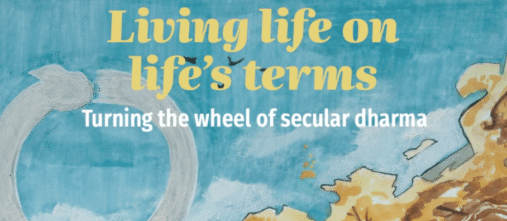
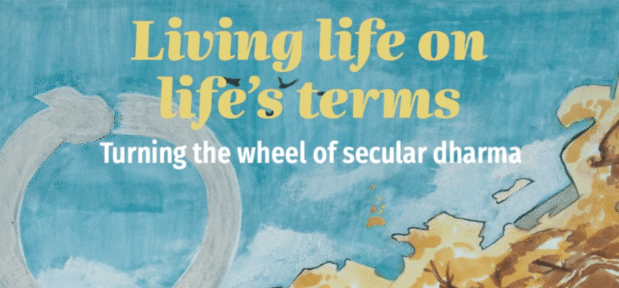
Book Launch: Living Life on Life’s Terms
Bodhi College is hosting an online event on September 30 to celebrate the publication of a new book, Living Life on Life's Terms, by Stephen Batchelor, Martine Batchelor, and Bernat Font.
By Signe Glahn

New Mindfulness-Based Ethical Living (MBEL) Courses Available for English Speakers
Registration is now open for the first English language courses of the revised version of the Mindfulness-Based Ethical Living (MBEL) course.
By Ulla König
EXPLORE COURSES & RETREATS

New Mindfulness-Based Ethical Living (MBEL) Courses Available for English Speakers

By Ulla König
Our Suffering Is Not a Private Matter (and what it costs the people standing nearest)

By Jeffrey Fracher
Book Review of Living Life on Life’s Terms: Turning the Wheel of Secular Dharma
By Anne-Laure Brousseau